Showing posts with label counseling. Show all posts

Sunday, June 20, 2010

Divorce Rates are Dropping

Everyone knows that 50% of marriages end in divorce, right?

Wrong. And right. For the generation born in the 1950's and married in the 1970's the divorce rate is hovering at just about the 50% line. However did you know that if the wife has at least a college degree the likelihood of divorce drops to 23?. When I have discussed this trend with my friends they weren't aware of this companion factoid.

But this is not true for subsequent generations. Generations marrying since the 1970's have seen a significant decrease in divorce rates for both college and high school graduates. As stated above, divorce rates after 10 years for the generation married during the 1970s for college graduates is 23 percent. However the rates of divorce drops to 20% for the those married in the 1980's with a college degree and 16% for those married in the 1990s. Parker-Pope gives several different reasons for why the divorce rate is declining.

This is just one of the surprising findings I discovered in Tara Parker-Pope's For Better: The Science of a Good Marriage. I also learned that gay and straight couples fight differently. John Gottmann, the preeminent researcher on marriage, along with Robert Levenson did a 12-year study comparing straight and gay marriages. They found that gay and straight couples fight differently; gay couples fight more fairly with fewer verbal attacks and "each partner made more of an effort to defuse the confrontation. The use of controlling and hostile emotional tactics, like belligerence and domineering, also were less common among gay couples."

Lastly, this book gave me lots of interesting articles and resources to pursue for future research and exploration.

For Better is a popscience book with the problems inherent in that genre. Even though it has almost 200 references, I would still like more references. She is a blog writer for the New York Times and the book has a gossipy air. While the book is ostensibly about what makes marriage work, For Better focuses more on divorce than on factors that keep couples together.

Saying that, For Better is a quick and informative read. It shifted my view of marriage and for that I am appreciative. I would recommend it to anyone who wants to know the state of modern American marriage. I am really glad I read this book.
Wednesday, April 28, 2010

When I Start my Practice I will Definitely Buy this


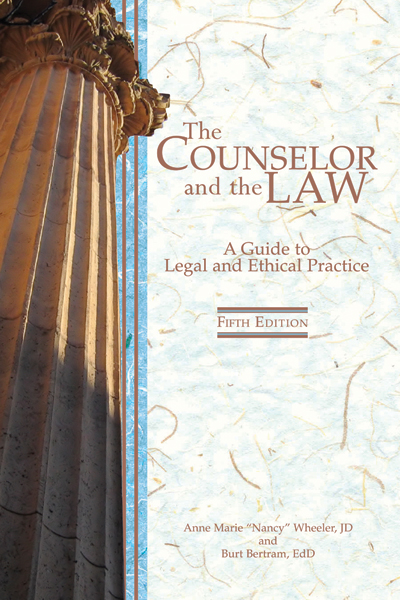
On my daily walk with my dog, I enjoy listening to the ACA's podcast. Anne Marie Wheeler and Burt Bertam the authors of The Counselor and the Law: A Guide to Legal and Ethical Practice, Fifth Edition were the first guests on the ACA's series. I would encourage anyone interested in mental health to check it out. You can find them here. Through the ACA website only members can from their podcasts. However, you can also access this program through iTunes.

If you are a counselor or are thinking about becoming one, I would highly recommend reading this book. Lacking legalese, it is is both intensely readable and practical. Wheeler is a lawyer who manages the risk management helpline for the American Counseling Association, while Bertam has been a practicing counselor for several decades. Together the two conduct seminars across America helping counselors appreciate the law and manage risk.

This is the fifth edition. The first edition was originally published in 1975 and the previous edition was produced in 1996, so we clearly needed a new update. One of the most important aspects that the new authors added was a section about HIPAA and how it affects the counselor. Before I read their book, I wasn't aware of some of the ramifications that HIPAA had on the counseling profession including how information is released to third party payers and what goes into a client's notes.

The Counselor and the Law is not just a list of do's and don'ts (don't's?) it also provides the counselor with a framework to understand why some of the laws are in place. This then promotes aspirational ethics and leads one to a better understanding of how a good practice is supported by ethics.

This book covers such topics as
* Confidentiality, privilege, and HIPPA,
* Duty to report, warn, and protect
* Suicide threats and how to deal with them
* Professional boundaries
* Record keeping,
* Who is the client?

One of my favorite parts of the book is Appendix C titled Top Ten Risk Management Strategies. The ACA has outlined concrete steps to help counselors avoid becoming legally liable.

In addition, it has been mentioned on a couple of different platforms that if one reads this book and has insurance through the ACA, after passing a test about how the law informs the counseling profession that one can be 10% off their insurance for the next three years.